Research Writing
Ch2. Biomedia
Investigations of the Body
The focus of my discourse in this chapter centers on the conception of the body in western culture. Whether as a vessel for the spirit, a mere object of control, virtual information or self-organizing systems, the body, even in absence, has always been the site of life and the foundation for an understanding of self. Our perception of the corporeal steers the direction of technological bodily intervention and shapes the way we interface with (what is understood as) living material. Paradoxically, these perceptions bring with them a discomfort and fear that manifests within the biopolitical dialogue of the present day. Through analysis of the Anatomical body and the Posthuman body, I hope to advance a critique of existing arguments for a bioethical future.
2.1 Insides and Outsides: The Anatomical Body
In his introduction to Anatomy Live: Performance and the Operating Theatre, Maaike Bleeker presents a conversation documented in Maurice Leenhardt’s Do Kamo: Person and Myth in a Melanesian World between the author and an elderly indigenous philosopher:
Leenhardt suggested that the Europeans had introduced the notion of ‘spirit’ to the indigenous thought. His interlocutor did not agree and remarked that on the contrary, they have ‘always acted in accord with the spirit’. What the Europeans brought to the Canaques was the notion of body.[43]
[43] Bleeker, Maaike, Anatomy Live: Performance and the Operating Theatre. Amsterdam University Press, 2008.
In Thomas Csordas’ interpretation of the conversation, he notes it is under the belief that the body is aligned with nature and the spirit with civilization that Leenhardt makes his suggestion. The spirit holds sovereignty over body, as civilization conquers savagery, and culture overcomes nature. Csordas suggests that the Canaque philosopher is led to a distinction between the objectified body and the mythical body, hence with his response, implies a realization of complete individuality, which correlates with western modernity. However, Bleeker points out that Csordas overlooks a difference in the meaning of “biological body” in cultural context. From the perspective of the Canaque philosopher, what is introduced is a western conception of the body in which an emphasis is put on absolute materiality, and it is this perception that he sees as different from his own beliefs, and therefore, new[44].
[44] Bleeker, Maaike, Anatomy Live: Performance and the Operating Theatre. Amsterdam University Press, 2008.
The purpose of this anecdote is not to critique either European or Canaque notion of the body, but to indicate that apart from popular belief, it is not the spirit that separates the concept of western life from other cultures, but rather an objectification and downplay of the body that makes it distinctive. It is this ideological distinction that paved the road towards a practice of material manipulation of the body, and consequently, life.
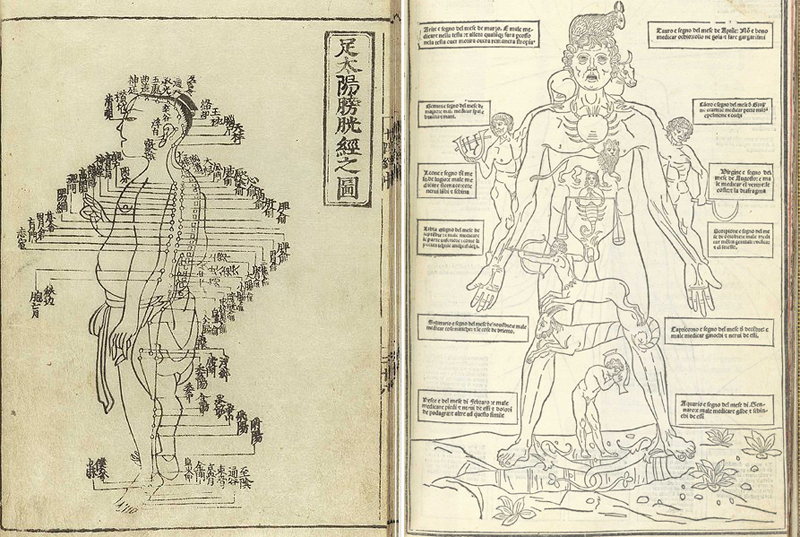
The modern view of the body in the west is built on the medical practice of dissection, which didn’t become common until the rise of the anatomical theatre in the late Renaissance. Early studies of the body are documented in medical illustrations that resemble that of eastern cultures such as Islam and China[45][46]. What eventually caused western medicine to deviate was the belief in visual perception as a means to unveiling scientific truth. Seeing, a skill originally acquired in art practice in ancient Greek, in time carried over to medical practice and provided the bases to what developed into the medico-scientific gaze.[47]
[45] Matuk, Amillia. "Seeing the Body: The Divergence of Ancient Chinese and Western Medical Illustration". JBC Vol. 32 No. 1. 2006.
[46] Acupuncture chart from Hua Shou, 1340s (Left),
Zodiac Man, 1493 (Right).
[47] Matuk, Amillia. "Seeing the Body: The Divergence of Ancient Chinese and Western Medical Illustration". JBC Vol. 32 No. 1. 2006.
One of the main roles of the anatomical theatre was to accommodate for medical education. The 16th century brought the private dissection lesson, a crucial means for medical students to engage in learning of the life process, into the public sphere[48]. To disclose knowledge of the living body, it was necessary for the master anatomist to cut open the body and visually unveil the secret of its inner workings. The spectacle inserted into the collective consciousness a notion of interior and exterior of the individual, where a critical border provided protection of one’s vitality. The open cadaver, deprived of its defense, lies lifeless, devoid of spirit and is reduced to an inanimate object. This sense of vulnerability reinforced the necessity to uphold the dividing line between the fragile and the foreign.
[48] Matuk, Amillia. "Seeing the Body: The Divergence of Ancient Chinese and Western Medical Illustration". JBC Vol. 32 No. 1. 2006.
Furthermore, the sense of boundary was also accompanied by a notion of ownership and control over the body made possible by the establishment of a new language used to describe its interior. This was the language of Columbian exploration. In The Body Emblazoned: Dissection and the Human Body in Renaissance Culture, Jonathan Sawday observes:
[t]o the natural philosophers of the earlier seventeenth century, it was not a mechanistic structure that they first encountered as they embarked upon the project of unraveling the body’s recesses. Rather, they found themselves wandering within a geographical entity. The body was territory, an (yet) undiscovered country, a location which demanded from its explorers skills which seemed analogous to those displayed by the heroic voyagers across the terrestrial globe.[49]
[49] Bleeker, Maaike, Anatomy Live: Performance and the Operating Theatre. Amsterdam University Press, 2008.
Andreas Vesalius, one of the earliest anatomists to hold public lessons, was the first to promote empirical evidence over abstract theory, a dominant system at the time established by Galen in the 14th century[50]. Prior, the theoretical notes of the anatomists held authority over the actuality of the physical body. Cadaver dissection was ornamental. The anatomist dictated from afar, never directly interacting with the corpse, while an assistant executed dissection of the body. The hands-on approach brought anatomists into the unexplored cavities of the human body where like the colonial voyagers, these “explorers” were eager to identify and define borders of this newfound wealth.
[50] Bleeker, Maaike, Anatomy Live: Performance and the Operating Theatre. Amsterdam University Press, 2008.
Like property, the body’s bounds needed to be fixed, its dimensions properly measured, its resources charted. Its ‘new’ owner – which would eventually become the thinking process of the Cartesian cogito – had to know what it was that was owned before use could be made of it.[51]
[51] Bleeker, Maaike, Anatomy Live: Performance and the Operating Theatre. Amsterdam University Press, 2008.
This metaphoric language of exploration and frontier still resonates in today’s scientific narrative and popular sci-fi literature. The ownership and control of the body, as well as a definitive boundary of the person helped establish the Cartesian subjectivity that still prevails in today’s society. However, the 20th century would see the deconstruction of this modern body and a new sense of corporeal identity would emerge.
2.2 The Collapse of Borders: The Posthuman Body
We need first to understand that the human form – including human desire and all its external representations – may be changing radically, and thus must be re-visioned. We need to understand that five hundred years of humanism may be coming to an end as humanism transforms itself into something that we must helplessly call post-humanism.[52]
[52] Hayles, N. Katherine, How We Became Posthuman: Virtual Bodies in Cybernetics, Literature, and Informatics. Chicago, London: University of Chicago Press, 1999.
There are as many Posthuman theories as there are Posthuman theorists. Additionally, various theories can often be in contradiction with each other. Therefore, it is very hard to put forth an all-encompassing, coherent definition of what Posthumanism is. However, what can be defined are a number of common characteristics and tendencies. Posthumanism more often than not is a reaction to a predominant Humanism. Though at times extreme, this reaction is not necessarily always opposing. Theories often strive to deconstruct the boundaries established by dualism and determinism in the western tradition, to embrace more fluid, complex and relative forms of thinking. This is represented in the image of the cyborg, shorthand for cybernetic organism. Conventionally understood as hybrid of man and machine, the image of the cyborg is expanded in Posthuman inquiries to include hybrids between man/woman, animal/human, object/subject, etc.
Posthuman discourse developed over the 20th century from a broad collection of domains and practices. Notable figures include Michel Foucault[53], Judith Butler[54], Bruno Latour[55], N. Katherine Hayles, Donna Haraway[56] and Robert Pepperell[57] to name a few. For the purpose of my own investigation, I would like to base my following discussions within the context of N. Katherine Hayles’ framework of thought. There are two main reasons for this: Firstly, Hayles’ dissertation closely investigates the relationship between technology (in the form of Cybernetics) and biological life, with an emphasis on the material body. Secondly, she evades political and social discussions (in the case of this thesis adds unnecessary complexity), and provides a structurally clear theoretical scaffold upon which further analysis and critique can be built.
[54] Posthumanist Performativity: Toward an Understanding of How Matter Comes to Matter
[55] Forgetting to be (Post)Human: Media and Memory in a Kairotic Age
[56] A Cyborg Manifesto
[57] Pepperell, Robert, The Posthuman Condition: Consciousness Beyond the Brain. UK, USA: Cromwell Press, 1995.
Hayles credits the beginning of a Posthumanist theory with the emergence of cybernetics in the mid 20th century. She observed that information technologies were creating scenarios that increasingly complicated liberal humanist ideals where the human body was constantly put to question. Contemporary cybernetics was defined by Norbert Wiener as “the scientific study of control and communication in the animal and the machine”. A main area of concern was that of information technology and theory, although cybernetics also engaged disciplines such as cognitive science, computer simulation, computational biology, artificial intelligence and artificial life. Through comparison of technological and biological systems, cybernetics advanced system theories that were perceived to apply to all aspects of life. The historical development of these theories can be divided into three stages, known respectively as First-Order, Second-Order and Third-Order Cybernetics. To understand how the anatomical body was transformed within this context, we must individually examine the concepts put forth during the respective stages.
Developed between 1945 and 1960, the First-Order Cybernetics was mainly fascinated with information and information transformation on a theoretical level. Claude Shannon established information as a probability function with no dimensions, no materiality and no connection with meaning. Two aspects of this definition are crucial for instituting communication: The disembodiment of information allowed it to flow through different mediums while a detachment from meaning established homeostasis where information remained quantatively unchanged as it traveled from one context to another within a network. The more favorable stability of this mathematical model allowed information to triumph over chaotic materiality, which became a major theme at the first Macy Conference. Warren McCulloch, a philosopher turned neurophysiologist, pushed this theory to the next level by making a connection between information processing and the human capacity to process information. His model of a simple neuron network, which came to be called the McCulloch-Pitts neuron, presented that the human brain was capable of similar mathematical activity through neurological systems. Despite its reductive imperfections, the McCulloch-Pitts neuron theory became enormously influential during the conference. Norbert Wiener posited that information was the important element that established the man-machine connection.
The Second-Order Cybernetics evolved between 1960 and 1980. Its major concern centered on the idea of reflexivity, brought forth through observation of biological organisms that inserted the element of subjectivity into systematic studies. “What the Frog’s Eye Tells the Frog’s Brain”, an article published by the Macy group, demonstrated that the frog’s visual system did not so much represent reality as construct it. Whereas leading figures of the team fixated on its empirical implication, Humberto Maturana, a young neurophysiologist who also took part in the research, was fascinated with the subjectivity of observation built into the frog. Continued experiments on the color perception of different animals brought Maturana to the conclusion that perception was not fundamentally representational. He asserted that prior conception of an objective world was misleading in that the sense of reality only came into existence through the construction of individual beings, and this construction was entirely reliant on the organism’s continued interactive process with the outer environment and its own internal systematic organization, or autopoiesis. Reversely, the individual itself is no longer an entity, but a conglomeration of systems – systems within the subject as well as larger environmental systems in which the subject belongs – that self organize and interface but never really interact with each other.
The Third-Order Cybernetics emerged in 1980 and continues into the present day. This new wave was heavily entangled with the field of Artificial Life, bringing with it an evolutionary uncertainty to Maturana’s autopoietic system theory. During the Fourth Conference on Artificial Life, Thomas S. Ray, an evolutionary biologist, set forth a proposal suggesting that if his Tierra – a software program capable of generating Artificial Life-forms contained in a single computer – is released onto the Internet, it would be able to generate new diverse “species” in other computers. Ray originally created Tierra as a computational model to understand the process of genetic mutation in evolution. Compared to the slow pace of natural evolution, the program was able to immediately present spontaneously emergent patterns. Here, the concept of the emergent system appears for the first time. It implies that properties and programs are able to appear from the system on their own in ways that cannot be anticipated by the creator of the simulation. It took on the logic of a bottom-up organizational approach that deviated drastically from the top-bottom approach of Artificial Intelligence. Ray asserted that systematic simulations of life (be they software or hardware) are themselves living in essence only artificial in material, and that Artificial Life should be considered a branch of theoretical biology.
As we examine the developmental stages of Cybernetics, we can devise that the body went through transformations of virtualization, and from there became systemically deconstructed and isolated from its surrounding environment, till the final stage where it’s inner hierarchy was reconfigured. Yet one thing remained consistent throughout, the body was never materialized, which Hayles in her book duly critiques. This conceptualization of the body (largely due to previous downplay of the physical body in modern times) has been proved problematic in today’s biopolitical debates, where the body as media is brought to the table for possible manipulation and the corporality of life itself is hard to ignore.
As afore mentioned, much of Posthuman theory is consumed with issues of society, gender and politics. In my opinion, these issues present mediated cultural metaphors that draws focus away from analysis of the bare structural relationships we build between technology and organic life. What is needed is a separation between these analysis and analysis based on relational, systemic approaches. Ed Keller makes such a distinction in his definition of the term Post Planetary, where he departs from investigations of the body and human nexus to examine larger networks, at times beyond human existence and comprehension. This approach also deviates from the deterministic systemic outlook presented by earlier American cybernetic theories mentioned above, and gravitates towards a more open systems way of thinking which I will elaborate in the following section.
2.3 Possible Futures
Manuel DeLanda in his “Nonorganic Life” talks about the idea of the “conservative system” and the “open system”[58]. The former informs much of the classical approach of western science, isolating the subject of inquiry within an artificial ideal environment, creating models that are simplistic, predictable and reductive of reality. However, most of nature is not isolated but spontaneous and complex. Anyone who has worked with physical materials can tell you the complexity and unpredictability of what we call reality. A contained view of the world based on linear mathematical equations and superimposed concepts create blind spots that prevent researchers from “seeing” the nuances in natural phenomena. It is only when we break away from our expectations derived from experience with these conservative systems that we are able to observe the larger world for simply what it is. As DeLanda writes in the very beginning of his article:
[58] DeLanda, Manuel. "Nonorganic Life". Zone 6: Incorporations. 1995.
Unlike Chinese astronomers, who had been able to observe the occurrence of sunspots centuries before Galileo simply because their cosmological beliefs did not preclude celestial change, early Western astronomers were unable to “see” changes in the cosmos. Sunspots, for example, remained “invisible” – that is, insignificant and anomalous – until Copernicus’s ideas changed the ways in which European astronomers look at the heavens.[59]
[59] DeLanda, Manuel. "Nonorganic Life". Zone 6: Incorporations. 1995.
In the same sense, beginning from mid 20th century, shifts in the study of thermodynamics slowly began to uncover new discoveries of how energy and matter transferred and manifested. Ilya Prigogine[60] and others contributed to the observation that within an equilibrium state (much like a conservative system), matter is blind and predictable, but when a system becomes far from equilibrium (such as in open systems), it becomes capable of “perceiving” weak gravitational and magnetic influences, where matter must then be put into consideration within the system of impact that could potentially cause it to behave in unintuitive ways. A classic example of this type of phenomenon is the Belousov-Zhabotinsky reaction[61]. One assumes that the mixing of purple and blue molecules would create a stable violet colored liquid, but instead, the compound can oscillates between blue and purple for an extended period of time without settling for a single color. Such far-from-equilibrium system[62] models constitute the majority of situations in the natural world where the more factors of influence is, the more unpredictable the outcomes would be.
DeLanda presumes:
If we also imagine that these chemical(s) (processes) accumulate on a “tape” – some kind of natural storage device, like a self-replicating macromolecule – the spatial patterns generated will be as asymmetric and information-rich as those we observe in organic life.[63]
[63] DeLanda, Manuel. "Nonorganic Life". Zone 6: Incorporations. 1995.
If materials are autonomous and expressive, unpredictable and complex, what role then does the artist play, and what approach should he take? In the following, I would like to present three examples that start to point at a possible new methodology in art practice.
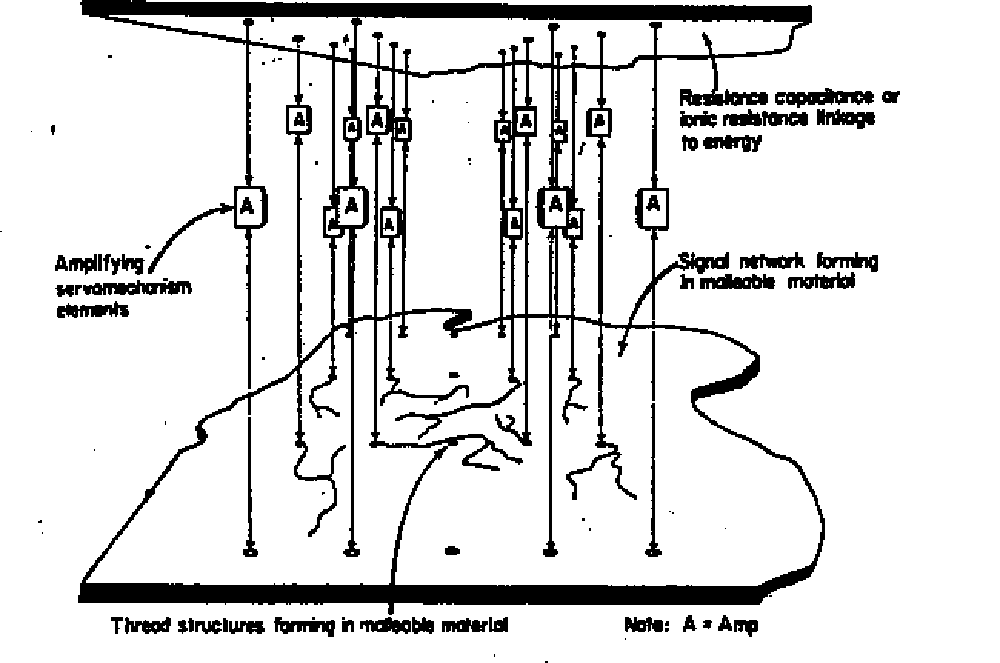
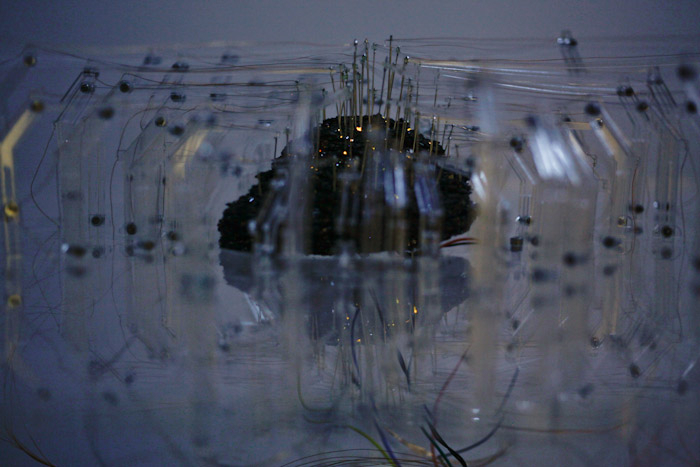
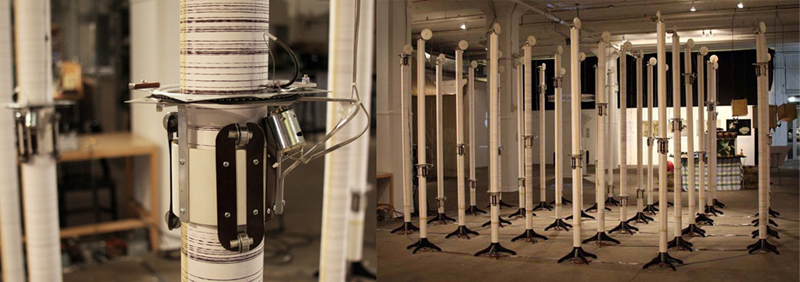
The first is the chemical computers[64] developed by British Cybernetician Gordon Pask. The [64] image presents a schematic of an electrode array embedded in ferrous sulphate, a conductive medium. Electricity flows through the material in unpredictable ways that form random circuits within matter[65]. Another example is the media art Irrational Computing created by the artist Ralf Baecker[66][67]. Through the work, Baecker tests the material, esthetics and potentials of the digital through computational experiments with semiconductor crystals, the material basis for information technology. The artist seeks to reveal the poetic boarder between “accuracy” and “chaos”. A final example is the project Silent Barrage, a collaboration between Philip Gamblen, Guy Ben-Ary, Peter Gee, Dr. Nathan Scott, Brett Murray and Dr. Steve Potter Lab[68][69]. The piece takes movement of the audience within the exhibition space and feeds it to cultured nerve cells in petri dishes, where neurological activity is then output to robotic poles that document the activity.
[64] Gordon Pask's Schematic for a Chemical Computer
[65] Pickering, Andrew, The Cybernetic Brain: Sketches of Another Future. Chicago, London: University of Chicago Press, 2010.
[66] www.rlfbckr.org
[67] Irrational Computing, Ralf Baecker.
[68] silentbarrage.com
[69] Silent Barrage.
What is common across these works is, the artist/engineer/scientist ceases to take the position of “creator”. Instead, they assume the role of facilitator and construct circumstances that allow for the work to emerge and unfold. This approach has it’s similarities with the concept of “non-doing (无为)”[70] in Taoism. Friedrich Nietzsche once questioned:
[70] Tao Te Ching (道德经).
I know something and seek a reason for it: … I seek an intention in it, and above all someone who has intentions, a subject, a doer: every event a deed – formerly one saw intentions in all events, this is our oldest habit. Do animals also possess it?[71]
[71] "Philosophical Perspectives on Behavior: From Animism to Materialism". The Things We Do: Philosophical Perspectives on Behavior.
A tree does not think to grow its leaves, a fish does not think to swim through the water. The bird is of its birdness, the rock is of its rockness, effortless and natural. Intention becomes empty, one can only be. Subjectivity dissolves into the “ten thousand things(万物)”[72] and becomes one with the unified whole. In a world where technology and human intervention is so commonly portrayed as forceful and aggressive, such an approach to media art might present an interesting alternative.
[72] Tao Te Ching (道德经). Ten thousand things implies everything in the universe. The use of numbers in ancient Chinese culture is metaphorical.
Bibliography
Bleeker, Maaike, Anatomy Live: Performance and the Operating Theatre. Amsterdam University Press, 2008.
Matuk, Amillia. "Seeing the Body: The Divergence of Ancient Chinese and Western Medical Illustration". JBC Vol. 32 No. 1. 2006.
Hayles, N. Katherine, How We Became Posthuman: Virtual Bodies in Cybernetics, Literature, and Informatics. Chicago, London: University of Chicago Press, 1999.
Foucault, Michel. "The Birth of Bio-Politics".
Butler, Judith. "Posthumanist Performativity: Towards an Understanding of How Matter Comes to Matter".
Latour, Bruno. Forgetting to be (Post)Human: Media and Memory in a Kairotic Age".
Haraway, Donna. "A Cyborg Manifesto".
Pepperell, Robert, The Posthuman Condition: Consciousness Beyond the Brain. UK, USA: Cromwell Press, 1995.
DeLanda, Manuel. "Nonorganic Life". Zone 6: Incorporations. 1995.
Pickering, Andrew, The Cybernetic Brain: Sketches of Another Future. Chicago, London: University of Chicago Press, 2010.
Tao Te Ching (道德经)
"Philosophical Perspectives on Behavior: From Animism to Materialism". The Things We Do: Philosophical Perspectives on Behavior.