Living Devices
Materials: bacteria (E. coli), electronics, petri plates
fall 2012 - spring 2013
Living Devices is a series of research methods, lab protocols, hardware developments and experiment specimens that seek to break down the barrier between machine and organism by transforming electric signals into emergent bacteria growth patterns within a single device. The device allows access into the living system of bacteria through electric stimulation and manipulate their growth outcome to form visual pattern.
A set of protocols were developed to easily interface petri dish cultures with electrical stimulation. The interfacing system allows control of individual electrodes within a multi-node configuration to generate non-unified, diverse and dynamic electric voltage environments for testing.
The case study of 2012 to 2013 utilizes the JM109 strain of E. coli to obtain knowledge of preliminary bacterial responses. Stimulation experiments have resulted in finding electric ranges that create new growth results. Future research seeks to expand into other species of single cell organisms.
Living Devices offers an artistic speculation of future bio-electrical devices.
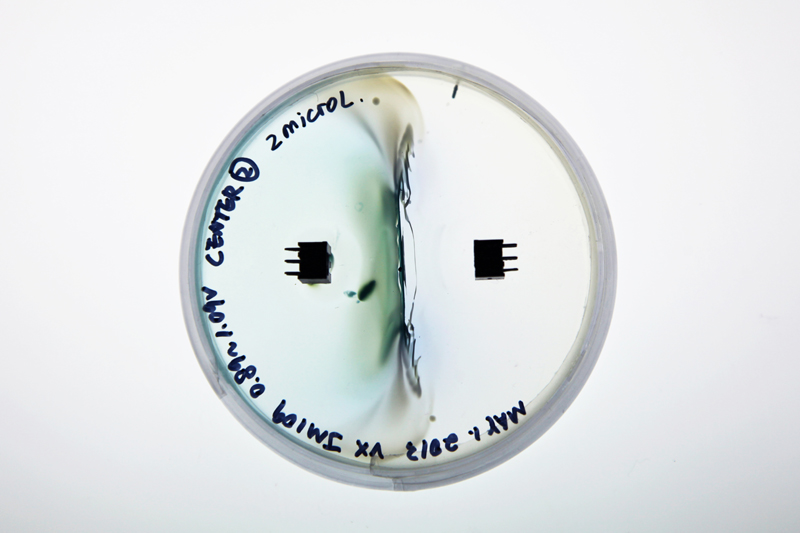
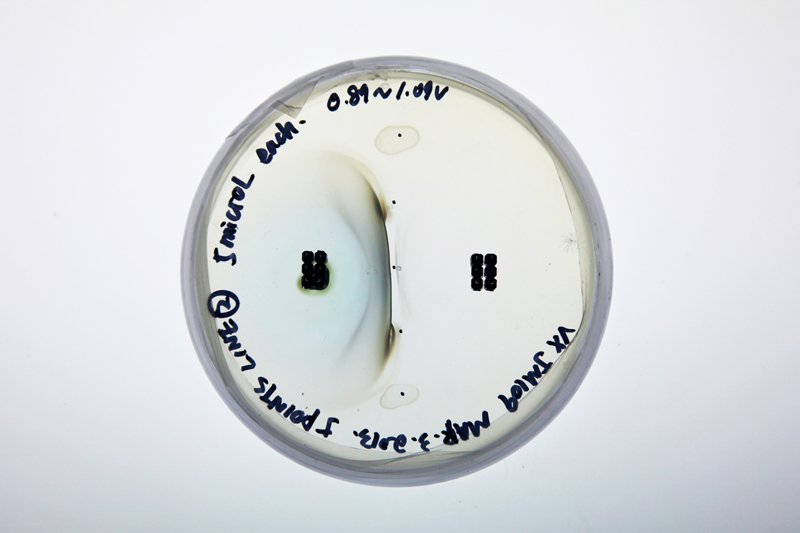
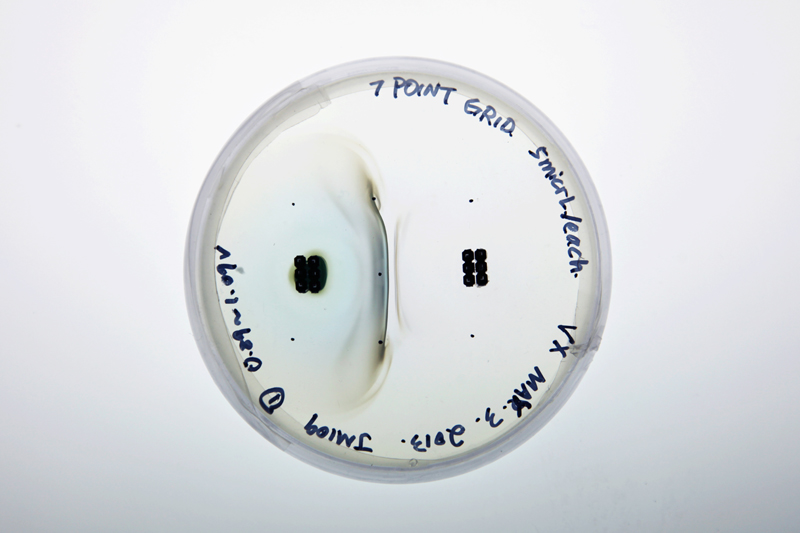 Experiment results from single voltage level stimulation
 Thesis exhibition display, shown in the 2013 MFA Design + Technology Thesis Show
 Electric Plates display on light box
 Preserved Specimens (E. coli Bacteria) on light box
 Test results of single and dual level stimulation of E. coli bacteria, voltage stimulation
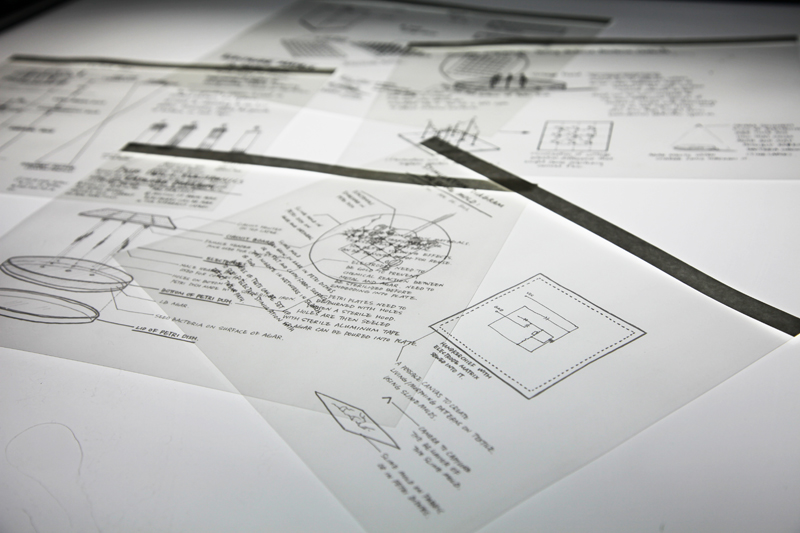
 Design sketches of stimulation system on light box
Performative video of main protocols developed for Living Devices (source from vimeo, if in China, will need VPN):